The Eastern Monarch Migration intrigued scientists for many years.
Where did these butterflies stay during winter?
Dr. Fred Urquhart, a zoologist working at the University of Toronto, began a quest to find out the answer to this question in 1935. His motivation to solve this mystery resulted in 40 years of research.
He tried to find a Monarch butterfly tracker that could provide the information he needed to find out exactly what happened to the Monarchs.
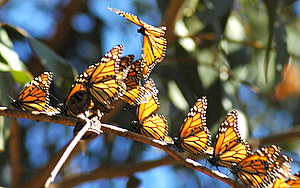
In the 1950's he found a wing tag that could carry information and not disturb the Monarch's flight.
It was a small circular sticker applied to a specific part of the wing. This Monarch butterfly tracker acted like the bands that had been used to track bird migration.
By 1964, about 70,000 butterflies had been tagged. The tag sightings proved that Mexico was probably the destination of the Monarchs. Where in Mexico.......was still a mystery.
Discovery of the first winter roost was on January 2, 1975 by Ken and Cathy Brugger, part of Urquhart's volunteer team.
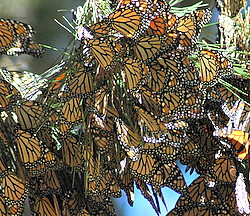
With the help of local woodcutters, they found 100's of millions of Monarchs on a thick grove of Oyamel Fir Trees while hiking close to the summit of Cerro Pelon in South Central Mexico.
Another dozen
roosting sites were found in thick Oyamel forests
, all at an altitude of 2 miles within a radius of 50 miles of Cerro Pelon. These Oyamel Firs provided great protection for the Monarchs.
Current figures show there are a half dozen or so main colonies and more than 30 sites.
About 30 - 100 million Monarchs make it to the roosting sites each year. This is only a percentage of those that set out on the journey.
These roosting sites are:
44-105 miles west of Mexico City.
in Oyamel Fir forests of the Mexico Transverse Neo-volcanic Range.
between 18-19 degrees North latitude.
at an average elevation of 8200 feet up to 12000 feet.
cold enough to promote torpor (semi-paralysis), but not freezing.


 In the 1950's he found a wing tag that could carry information and not disturb the Monarch's flight.