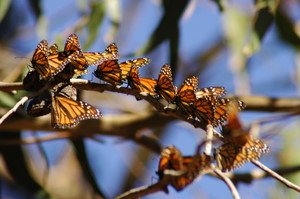
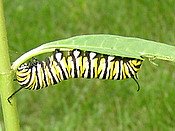
It is miraculous that the same butterfly that normally lives only 2-5 weeks can survive a journey of up to 2500 miles and live for many months, only because of WHEN it emerges. Let's explore this mystery.....
The Monarch Butterfly is tropical in origin. The
Milkweed family
, host plant of the Monarch Butterfly, also originated in the tropics.
A few of the 3,000 species of Milkweed was able to survive and thrive in areas far North of it's origin.
So, as the milkweed moved northward.....so did the Monarchs.
As winter approached in these colder climates, the Monarch had to travel South in order to survive. This began the Monarch Butterfly Migration.
Changes had to take place in the development of the Fall generation of Monarchs, in order for them to make the long migration journey.
How are these "Fall" butterflies different from the earlier generations?
During the caterpillar stage in late summer, three things signal a change in this generation's growth and development:
duration and intensity of light
falling temperatures
quality of milkweed
More energy is channeled to flight muscles and "lipid mass".... less to maturation of the Monarch's sex organs. The result is that this generation has no interest in mating....called, diapause.
These Monarchs develop heavier flight muscles and energy from nectar is stored in a "lipid mass" in the abdomen.
The average life span of the 3 or 4 preceding generations was 2- 5 weeks......now it is increased by 5-7 times.
Consider the following about the amazing Monarch Butterfly Migration:
Where do the Eastern Monarchs migrate?
How do the Monarchs migrate?
What happens to the Monarchs in Mexico?
When and how do the Monarchs return in Spring?
Where do the Western Monarchs migrate?
Find the answers to these questions and more, including Monarch Butterfly Migration Maps ....
Fall
and
Spring
..... in the pages to follow.